“The Work Remains Unfinished”: Inside a Day in the Youth Part With Judge Craig S. Walker
From homicides to college dreams: a full day with Judge Craig S. Walker in the busiest Youth Part in New York State. By Bro. Eugene L. Aiken III


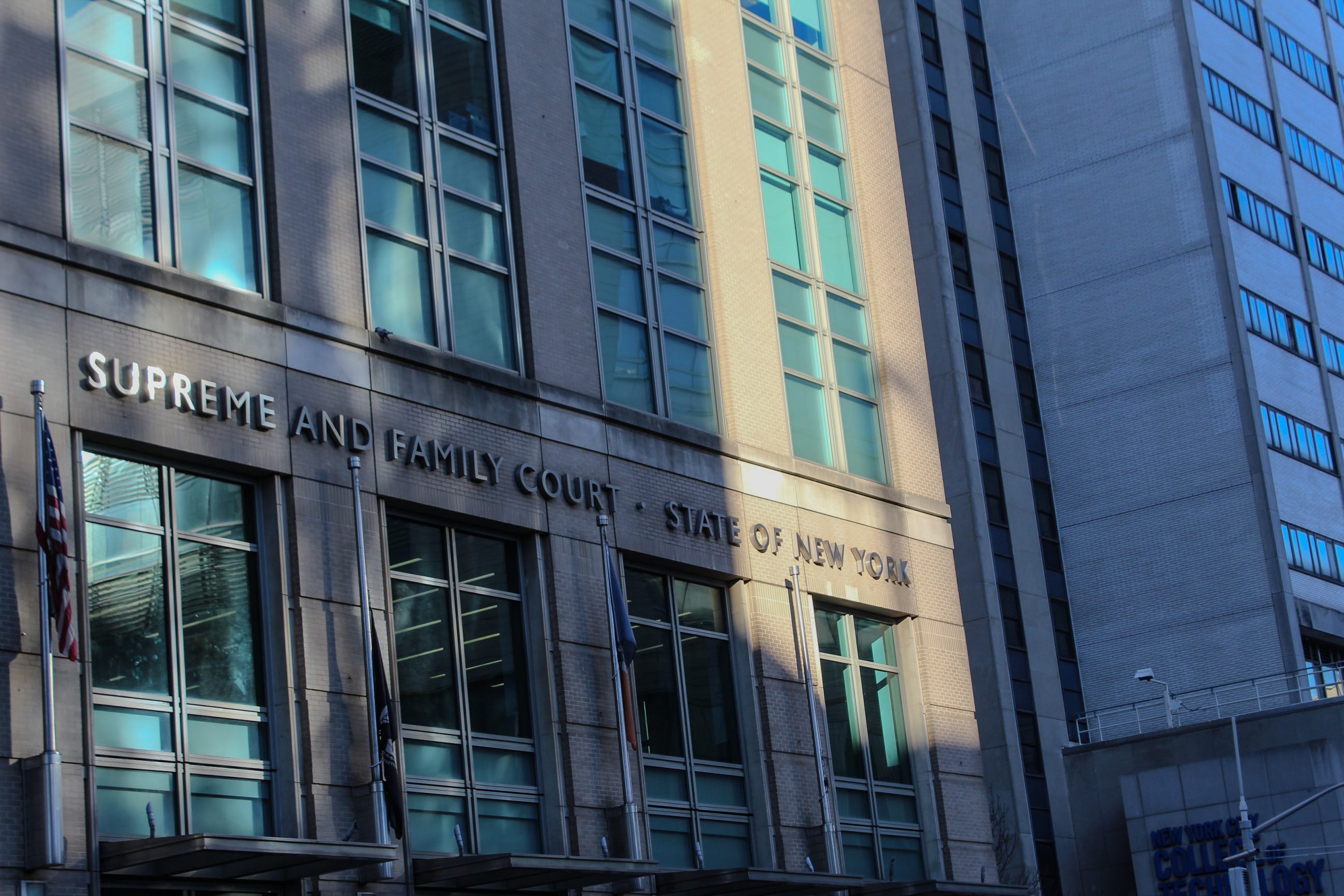
On a cold Tuesday morning in Brooklyn, I stepped through the doors of 320 Jay Street—the towering courthouse that houses Kings County Supreme Court. Mounted across the entryway wall in bold metal lettering were the words:
SUPREME COURT
STATE OF NEW YORK
COUNTY OF KINGS
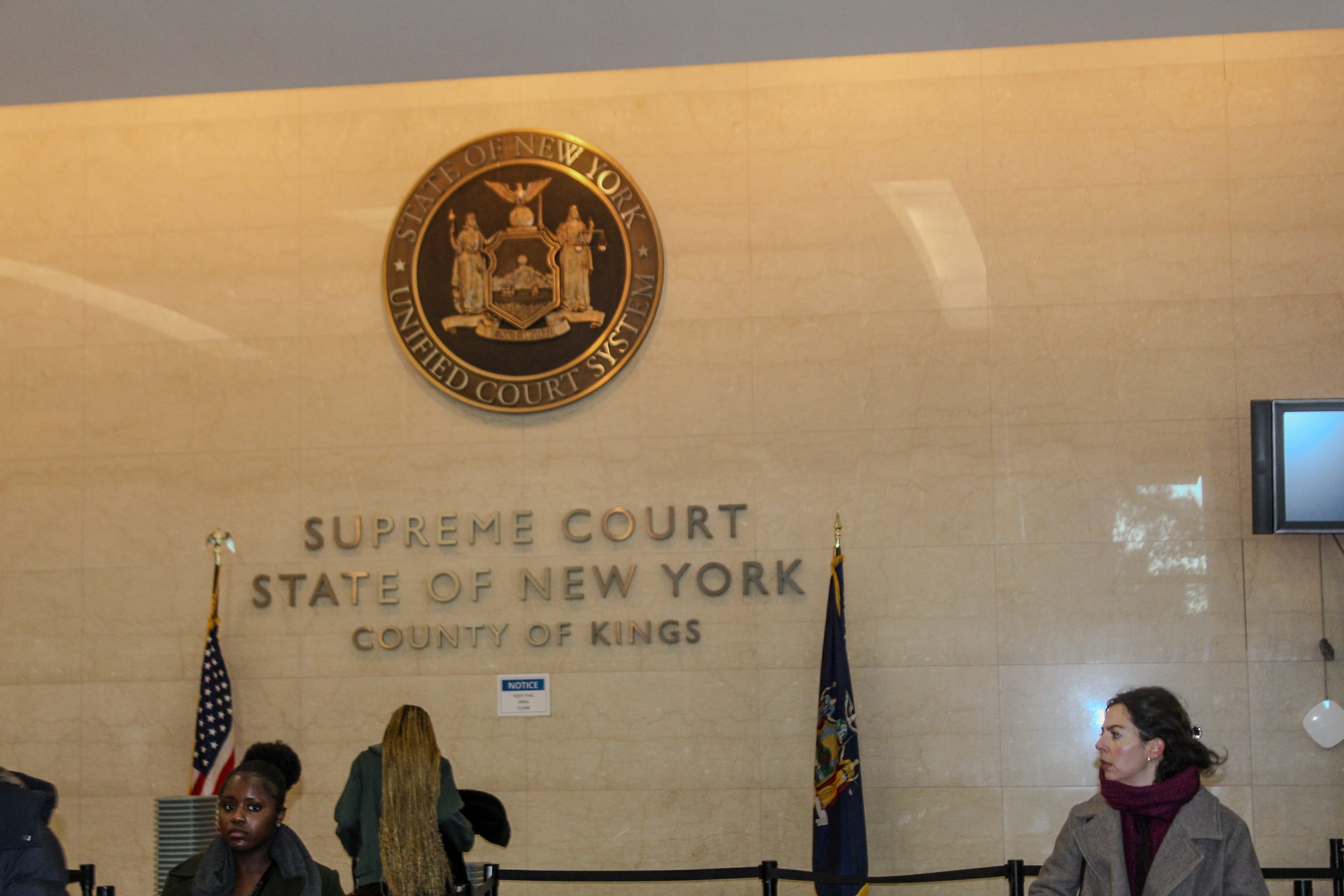
The New York State seal watched over the lobby like a silent referee. I snapped a photo of the wall with my DSLR—a simple act that immediately caught a court officer’s attention.
“Did you take that picture in here?” he asked.
“Yes.”
“You’ll have to leave the camera downstairs.”
But once I explained I was profiling Hon. Judge Craig S. Walker ΓΙΛ Spring ‘25, he picked up the phone, called upstairs, nodded once, and said, “You’re good. They’re expecting you.”
This would be the first of many small moments that revealed how deeply Judge Walker is known—and respected—inside this building.
More importantly—everyone respects him.
23rd Floor: A Chamber With a View
When the elevator opened onto the 23rd floor, a court officer greeted me warmly—he’d already been told I was on my way—and filled the waiting moments with a story about his hunting trip in Greene County. A buck and a doe, he said proudly.
Judge Walker appeared moments later. Tall, composed, unmistakably calm.
“Brother Aiken,” he said. “Come on back.”
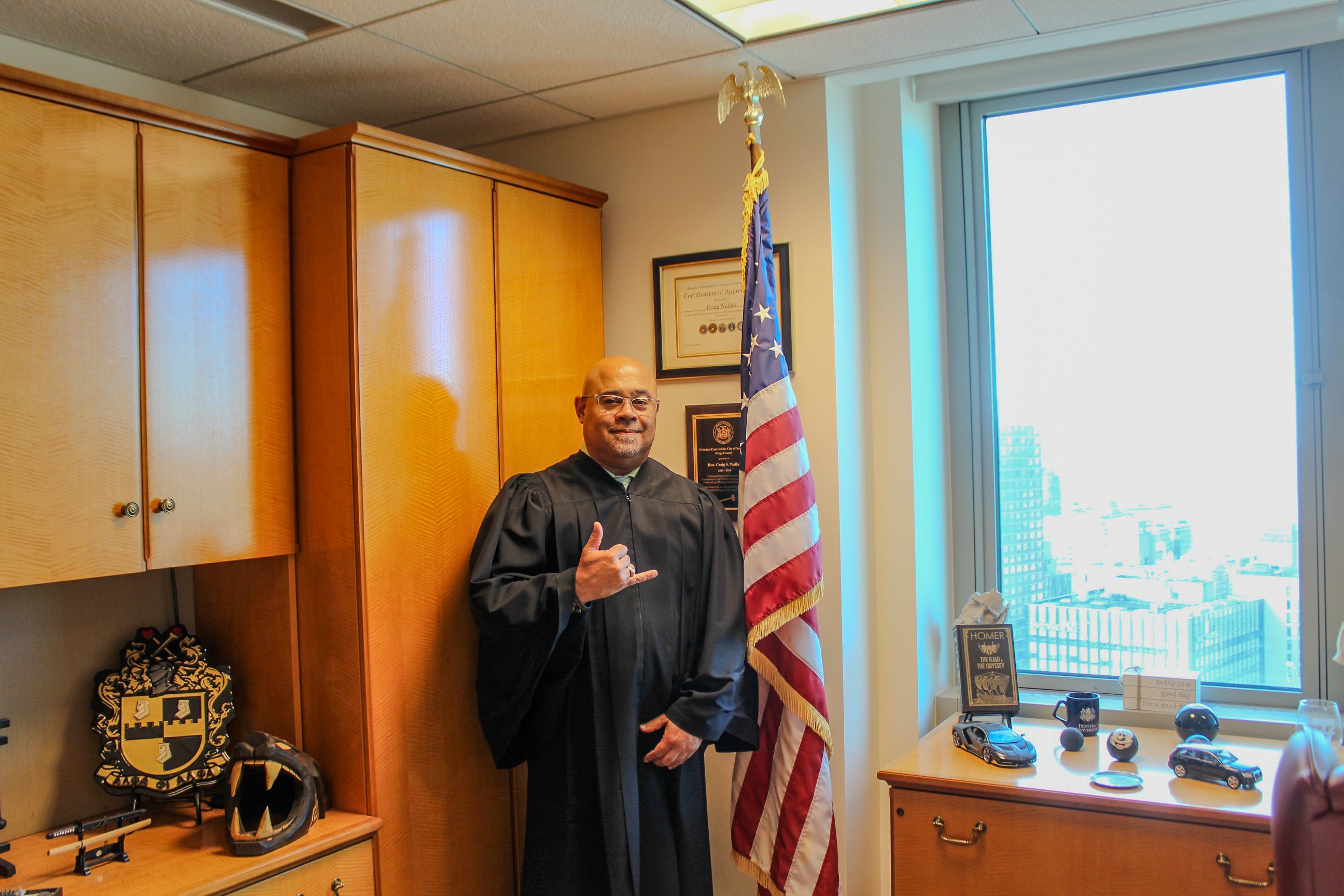
Inside his chambers, sunlight poured through enormous windows that overlooked New York Harbor. The Statue of Liberty stood framed in the glass like an emblem of the day’s work. He admitted he rarely has time to stop and look at it.

His chambers were a quiet autobiography:
Navy medals
A dual volume of Homer’s The Iliad & The Odyssey, and The Art of War
A handcrafted Alpha crest
A carved African mask
Photos, mementos, and a bookcase of legal tomes


His two court attorneys—Kemar Hermitt and Darius Johnson—both Black men, introduced themselves. Three Black legal professionals steering a courtroom that overwhelmingly hears the cases of Black and Latino boys.
We settled in. I set up my camera. And the first interview began.
INTERVIEW BLOCK A — PREPARATION, PURPOSE & THE YOUTH PART
“How do you prepare your mind for a day of adolescent cases?”
When I asked how he prepares his mind for a day of adolescent cases, he didn’t answer with a ritual. He answered with a framework.
“First, you have to understand what this part is,” he said. “This is the Youth Part, created under Raise the Age. If a young person is in front of me, something serious has happened.”
He laid out the architecture of the law like he was teaching a class.
Before October 2018, 16- and 17-year-olds in New York were automatically treated as adults in the criminal system. If bail was set, they went to Rikers Island, where a teenager could share space with a 50 or 60-year-old man. Raise the Age changed that. Now, most adolescent cases are supposed to start in—or be transferred to—Family Court. Only the most serious felonies stay in the Youth Part in Supreme Court.
“In Brooklyn,” he said, “that means I only see kids charged with felonies—murder, attempted murder, assaults, gun possession, shootings, burglaries, robberies, even fraud or credit card theft. Violent and nonviolent, but all serious.”
The ages are even starker.
“This part goes as young as 13,” he said. “And the only way I get a 13-year-old is if they’re charged with a homicide. From 13 to 17, that’s my world.”
He said it without drama, but the numbers are sobering.
Brooklyn alone—if it were a standalone city—would be the fourth-largest city in the United States. Walker’s Youth Part is widely acknowledged as the busiest in New York State. On some days, he’ll have over thirty cases. The Monday before I arrived, his calendar carried thirty-six.
“These are calendars full of red and yellow,” he explained to me later, showing a printout. “Red are my jail kids, coming from detention or Rikers because they’ve aged out. Yellow is everyone on the outside—kids on supervision, in school, in programs, trying to work off a non-jail disposition.”
But for him, preparation isn’t just about volume. It’s about perspective.
“You’re looking at someone charged with a violent felony,” he said. “But when the cuffs come off, they still look like what they are—a 14-year-old, a 15-year-old, a 16-year-old. You see the tears. You see the fear. My job is to remind myself: don’t just see the case caption. See the kid.”
That mindset is informed by the path that led him here.
Before he was Hon. Craig S. Walker, Youth Part judge, he was a civil litigator—and he will tell you openly that he once wanted nothing to do with criminal law.
“When I took criminal law in law school, I said to myself: ‘I want absolutely nothing to do with this,’” he admitted. “I couldn’t imagine being a prosecutor and putting away someone who might be innocent, or being a defense attorney and getting someone off I knew was guilty. It all felt too black and white.”
He laughs a little at that younger version of himself now. Life, he learned, isn’t that simple. After he was elected to the bench and assigned to criminal court, he thought he would only stay a couple of years before returning to civil court.
Then he started listening to people’s stories.
“Once I began to see who was coming through—what they were dealing with—and how much poverty, mental illness, addiction, and plain immaturity drives some of these cases, something shifted,” he said. “I realized there might be something I could do from this side to mitigate the impact on their lives.”
That realization drew him into what he calls “alternatives to incarceration” work: crafting plea agreements that prioritize treatment, education, and rehabilitation over automatic prison time when the law allows it.
“There’s a statute that allows for youthful offender adjudication up to age 19 on a first conviction,” he explained. “If I can, I’ll use that so a kid doesn’t walk around the rest of their life with a criminal record. Because a record closes doors—jobs, benefits, school, housing. Sometimes just having an open felony case means nobody will hire you.”
He’s also constantly weighing immigration consequences in the background.
“Some kids are undocumented or have shaky status. If I don’t pay attention to how a plea is structured, they could end up deported for something we could have handled differently. So I’m always asking: is there an immigration-friendly way to resolve this that still holds them accountable?”
When he talks about “preparing his mind” for the day, he’s talking about holding all of this in his head at once: the law, the stakes, the trauma, the options—and the fact that each case is a human being at a turning point.
“These kids are charged with serious things,” he said. “But I can’t just prepare to punish. I have to prepare to judge—with context, with nuance, and with the understanding that their lives aren’t finished yet.”
What Justice Looks Like in a Room Full of Kids
When I asked him, “What does justice look like for the young people who come before you?” he didn’t answer with statutes. He answered with demographics.
“About 98 percent of the kids who come before me look like us,” he said plainly. Black and brown. Almost entirely.
Then he dropped the statistic that kept ringing in my head all afternoon:
“In seven years of doing this, in the busiest youth part in New York State, I have never had a white kid charged with a firearm.”
He let the silence do some of the work. We were in Brooklyn—a borough of almost three million people, home to every race, class, and neighborhood.
“It’s not that white kids aren’t out here with guns,” he said. “But they’re not the ones being arrested and brought here.”
For him, justice can’t be detached from that reality.
“You have to look through a social justice lens,” he said. “Why is it that in a borough this big, with this much diversity, only one group of kids is standing in front of me on gun cases? Why is there this overrepresentation of Black and Latino youth?”
He doesn’t pretend to have a single neat answer, but he’s clear about the pattern: poverty, concentrated disadvantage, neighborhood violence, social networks, and policing patterns all play their part.
“The cases are coming from the same neighborhoods over and over—East New York, Crown Heights, Brownsville,” he said. “You’re not seeing these gun cases coming from Brooklyn Heights, Park Slope, Cobble Hill, Dumbo. It’s not happening.”
Then he layered in another dimension: trauma.
“I’m a military man,” he told me. “I was trained to go into combat—boot camp, psychological training, physical training. We all understand that when soldiers come back from war, they may have PTSD. No one questions that.”
He leaned forward a bit.
“Now think about a 15- or 16-year-old living in a neighborhood where there are regular shootings. Where they’ve been shot at. Where they’ve seen friends or family members shot. They’re living in a combat environment with no training and no treatment. We don’t treat them for PTSD. We don’t even acknowledge it. We just arrest them and try to throw them in a cage.”
Many of the programs he uses—Brooklyn-based initiatives with social workers, psychologists, and case managers—explicitly take a trauma-informed approach. They assess young people for mental health needs, family instability, school disruption, and community violence exposure.
“But it’s hard to get these kids to open up,” he said. “There’s a lack of trust. Imagine living in a world where the system has over-criminalized people who look like you. Why would you just open your soul to that system?”
So what does justice look like, in that context?
For Walker, it’s a balancing act between accountability, prevention, and possibility.
On the accountability side, he does not sugarcoat things. Many of the youth before him are charged with violent felonies—attempted murder, assault with knives, shootings caught clearly on video, gang conspiracies.
“These are serious cases,” he said. “Some kids are facing life sentences. Some have cases in multiple boroughs. People have been hurt. There are victims, and I never forget that.”
He knows the pressure from prosecutors and the public can pull in one direction: remand them, incarcerate them, send a message.
And yet, case after case, he is also asking a parallel set of questions:
Is this the young person’s first arrest?
What does their support system look like?
Are they in school? Can they be in school?
Are they engaged in any programs?
Is there a way to resolve this that avoids a lifelong criminal record while still recognizing the harm?
Justice, for him, is not just about what happens in the courtroom—it’s about what happens after.
“Most of my kids are in programs,” he said. “School, anti-violence programs, mentorship programs. Progress means they’re showing up, they’re engaging, they’re not picking up new cases.”
He’s not naïve about what’s happening.
“I always say: I can put a kid in a thousand programs, but if they’re not trying to understand what the program is teaching, it doesn’t mean anything,” he said. “I’ve had kids carrying guns while they’re in anti-gun programs.”
But even that, he connects back to fear rather than simple defiance.
“If you live in a world where you’re convinced your ‘ops’ are armed and waiting, the gun becomes a survival tool,” he explained. “We’ve had shootings right outside this courthouse. Kids know that when they come in here, they can’t bring a weapon, so their enemies are waiting outside. That’s insanity. And it’s the reality we’re dealing with.”
So justice, for him, looks like this:
Holding young people accountable for real harm.
Recognizing the structural and psychological forces that shaped their choices.
Giving them the maximum legal opportunity to avoid a record when possible (through youthful offender adjudication or Family Court transfers).
Making sure they are connected to school, employment, and therapeutic support.
And refusing to write them off as irredeemable at 13, 15, or 17.
“There’s no single factor that explains how a kid ends up here,” he said. “Some come from deep poverty. Some have intact families and parents in middle management jobs. Some are in gangs because that’s literally their family. You can’t point to one thing and say, ‘This is why.’”
But you can, he believes, decide what you do with them once they arrive.
“I can’t fix everything that happens outside these walls,” he said. “But I can decide whether I see them as monsters—or as kids who have done serious things in serious circumstances, who still have a chance to become something more.”
And in that sense, for him, justice looks like a possibility still open—not permanently closed.
THE COURTROOM — A MORNING INSIDE THE YOUTH PART
The Youth Part courtroom sits on one of the higher floors of the Kings County Supreme Court building, but once inside, it feels far removed from the city’s noise and bustle. The walls are an unadorned off-white, bordered by light wooden trim that wraps around the entire room. The overhead lights cast a steady glow that is neither warm nor cold, but the temperature of the room itself leans slightly toward chilly. You feel it the moment you sit, a reminder that this is a space built more for order than comfort.
A court officer announces, “All rise,” and a wave of mechanical movement ripples across the room—about two dozen people, attorneys, family members, caseworkers, program staff, and teenagers in streetwear straightening themselves in unison.
Judge Craig S. Walker steps onto the bench with a calm, measured presence. Beneath his black robe is a key-lime green shirt—an unexpected flash of color in an otherwise muted environment. He adjusts his clear glasses, nods to the room, and immediately begins perusing the docket handed to him by the clerk.
I sit in the witness box beside him, close enough to see the small pad of paper he writes on between cases. His handwriting is neat, deliberate, compact. Everything he does in this room is deliberate.
What struck me immediately was not the severity of the cases—though each one was serious in its own way—but the youth of the individuals before him. No matter what clothing they wore, whether it was a Nike tech fleece or a tailored blue suit, they all shared the look of adolescence: rounded cheeks, nervous eyes, fidgeting hands, the fragile bravado of boys trying to be men in a system that sees them only through the lens of their worst day.
Below is a fuller window into the morning.
Twenty-two cases.
Twenty-two lives at turning points.
Twenty-two stories of potential and peril unfolding one by one in a single courtroom.
CASE 1 — Project ECHO & a Gun Possession Charge
A young man in a grey Nike tech hoodie and black slacks stands before the judge. He is charged with possession of a firearm. His Legal Aid attorney reports he is actively engaged in Project ECHO.
Judge Walker asks him briefly about school, then says:
“If you stay committed, this program can keep you on track.”
The youth nods, quiet but attentive.
CASE 2 — Citi Bike Shooting
A young man in a skeleton-print hoodie is arraigned after a six-day review involving a shooting.
Video surveillance shows what appears to be him and a co-defendant on Citi Bikes holding a gun and firing it; a 13-year-old was injured.
The judge hands me sheets of paper with images of the teens on the Citi Bikes holding a gun in a “firing position”.
The boy surrenders his Belizean passport. His parents—an Uber driver and a school teacher—sit behind him.
It is his first arrest; he is a high-performing senior on track to graduate.
Defense requests release with supervision.
Judge Walker, balancing seriousness with possibility, orders an electronic monitoring assessment.
CASE 3 — McDonald’s Window Shooting
A young man in a red Guess puffer jacket and black sweatpants appears for his six-day review. He sits slouched in his chair, trying to project a nonchalant attitude, but the nervous tapping of his foot betrays the seriousness of what he’s facing. He is accused of firing a gun through the window of a McDonald’s on Atlantic Avenue.
In the middle of the hearing, a class of 7th graders on a field trip files into the jury box—a jarring backdrop to a case involving kids and gunfire.
The defense argues that the video evidence identifying him is weak, noting the footage relies heavily on a generic gray sweatsuit worn by the shooter. Judge Walker listens carefully, then walks through each piece of evidence with deliberate clarity, explaining how it fits together.
After reviewing the record, he finds the People have met their burden and rules that the case will remain in criminal court.
Before moving on, he turns to the young man and explains the decision plainly—what it means, what happens next, and what is expected of him. His tone is steady, firm but not punitive, ensuring the youth understands both the process and the gravity of the moment.
CASE 4 — Murder Charge After Extradition
A young man is brought in wearing handcuffs and neat pastel-colored clothing that soften the harshness of the situation. His demeanor is surprisingly friendly, and a boyish smile flashes across his face—despite the fresh scar running down his cheek, likely earned while in detention. He has been extradited from Panama after turning 18 and now faces a murder charge.
The contrast is striking: the gentle smile, the clean shirt, the pastel tones, and the severity of the accusation.
Despite the weight of the case, Walker addresses him with the same professionalism and humanity afforded to all who appear before him, keeping the courtroom grounded in due process rather than emotion or spectacle.
The details are severe, but Walker’s approach remains steady.
CASE 5 — Certificates From Detention
A young man in a green crewneck sweatshirt is brought in from a juvenile facility.
His attorney presents a stack of certificates he has earned, eleven in total—academic achievements showing strong performance despite incarceration.
Judge Walker reviews them and acknowledges the young man’s effort:
“Incarceration doesn’t raise your IQ, it just provides structure. This is evidence of your potential to be successful on the outside”
The boy appears proud, even relieved.
CASE 6 — The Student Who Visited Washington, D.C.
A young man in a black polo gives an update about a recent program trip to Washington, D.C.
He sat in congressional offices and met public officials through a program called Incredible Credible Messengers.
Judge Walker smiles, clearly energized:
“That’s the world I want you to see. You can be whatever you want to be.”
CASE 7 — The Blue Suit & Tearful Visitor
A young man is brought into the courtroom in handcuffs, dressed in a sharp blue suit with a blue shirt and red tie—an intentional effort to show respect despite coming from a detention facility. Judge Walker takes note of it and acknowledges the effort.
He is among several youths swept up in a recent gang investigation and now faces serious charges, including attempted murder and conspiracy. His defense attorney presents certificates from the educational programs he’s been completing while in custody, evidence of real progress. Judge Walker reviews them and remarks that hearing about academic achievement is something he values—not to impress the court, but to help position young men for success beyond their cases.
After the hearing, during the brief court-approved visit, a teenage girl meets with him. Overwhelmed, she begins to cry and tells him she loves him before he is led back into custody—an emotional reminder that despite the charges, these are still kids with people who care deeply about them.
CASE 8 — The Young Man With a Learning Disability
A small-framed youth in a gray suit appears, another teenager facing serious charges from a gang sweep.
The ADA recommends jail time.
Defense counsel approaches to disclose that the DOE found the youth has a significant learning disability and needs specialized school placement.
Walker listens carefully as the defense requests Family Court removal.
CASE 9 — The College-Bound Senior
A young man comes in for an update, smiling broadly as he talks about recent college visits and the acceptance letters he’s waiting on. He mentions a trip to SUNY Cortland with a sense of pride and possibility. His caseworker reports excellent progress in his program and speaks highly of his commitment.
Judge Walker’s response is warm and familiar—the two have built an easy rapport over previous appearances. He praises the young man’s effort and tells him he expects nothing less than excellence, a standard the youth seems genuinely motivated to meet.
It is one of the most positive updates of the day. For a moment, the courtroom feels lighter, filled with the energy of a young person who can clearly envision a life beyond his charges of attempted robbery and assault.
As he’s excused, Walker adds with a small smile, “Thank you for making my job easier today.”
INTERVIEW BLOCK C — Alpha, Leadership, Mentorship, and Public Service
By 1:20 p.m., 22 cases are complete. Walker rises, thanks the room, and we return to his chambers. He removes his robe, puts on a gray suit jacket, and we ride the private judges’ elevator down to the lobby. On the way to lunch, he greets several attorneys, court officers, and judges. Every greeting is mutual. Warm. Respectful.
When we sat down for lunch, something shifted subtly in Judge Walker’s demeanor. He relaxed and the conversation turned toward Alpha Phi Alpha and leadership.
Though he crossed into Alpha Phi Alpha only recently—Spring 2025 with the Gamma Iota Lambda Chapter—he made clear that the values of the fraternity had long been present in how he carried himself. New to Alpha, yes, but not new to leadership, service, or the sober responsibility of the law.
“I’ve worked around Alphas and other D9 folks my whole career,” he said. “But I see it differently now. You hear Brothers talk about what the fraternity means—brotherhood, scholarship, service—and once you’re in it, you actually feel what they were trying to describe for years.”
He described being mentored professionally by judges, prosecutors, and defense attorneys who were Alphas and AKAs. He’d been surrounded by the influence long before he became a member.
But crossing changed the vantage point.
“Now I understand the brotherhood from the inside. I understand what it means to stand among men who believe in uplifting the community—not through talk, but through action.”
He talked about representation, not as symbolism, but as embodiment.
“When people come into my chambers and see the Alpha crest behind me, see the paraphernalia—I want them to see what leadership rooted in service looks like. I want young Black men to walk in and say, ‘That’s what an Alpha man looks like in this position.’ Not for my ego. For what it signals to them.”
Then he tied Alpha’s tenets directly to his judicial work:
Manly Deeds
“This is showing up prepared. Showing up early. Setting expectations. Modeling discipline. I can’t ask these young men to take responsibility if I’m not doing it myself. If I’m late, unprepared, sloppy—what message does that send? Manly deeds means living the example.”
Scholarship
“This is where I get most excited,” he said. “When the kids come in with certificates, grades, achievements—when they voluntarily go to school inside the facility or enroll in GED programs—that’s scholarship. I want them to know education is their ticket out. I want them to be proud of their minds.”
He smiled with genuine pride when he talked about the boy who visited colleges upstate, and the one who met congressional leaders in Washington, D.C.
“They’re seeing the world outside their three-block radius—some for the first time. Scholarship means showing them those possibilities.”
Love for All Mankind
“You can’t do this work without love,” he said plainly. “You can’t sit where I sit and not care about them. Because then it becomes purely punitive. And punishment alone doesn’t build anything.”
He made a point about neutrality that many judges would shy away from.
“A judge is supposed to be neutral. But neutrality doesn’t mean indifference. I can be neutral and still show compassion. Still ask about their goals. Still encourage them. Still see them.”
Mentorship as Judicial Practice
“I see myself as a mentor,” he said, “even if I have to be careful with the boundaries.”
Sometimes he sees an attorney failing to advocate fully for a young person. He won’t overstep—but he will intervene to ensure the youth’s voice and progress are acknowledged.
“Sometimes I’m the only positive male figure they’ve had in their life,” he said. “And that’s not something I take lightly.”
He sees mentorship not as a speech or a lecture, but as consistency.
“Showing up the same way every day. No mood swings. No yelling. No disrespect. Because if they’ve never seen that before, how would they even know what stability looks like?”
Learning From Brothers
He spoke about leaning on older Brothers in the chapter, men who’ve been in Alpha 10, 15, 20 years.
“I came in older than many of them,” he said, “but they’ve been doing the work of Alpha longer than I have. So yes, I learn from the younger Brothers too. You have to have an open mind. Leadership isn’t about hierarchy. It’s about humility.”
He summed it up in a way that felt deeply true to who he is:
“I want to represent Alpha in the way I lead, the way I speak, the way I listen, and the way I judge.”
INTERVIEW BLOCK D — Personal Journey, Purpose, Legacy, and Honoring Judge Babatunde I. Akowe
The conversation about legacy began almost accidentally—after I asked what keeps him motivated on the hardest days.
He thought for a long moment.
“I think back to the positive experiences,” he said. “The kids who come in smiling because they’re doing well in school. The boy today whose entire trajectory changed because we gave him a chance. Those moments keep me going.”
Then he told me something that caught me off guard.
“When kids are incarcerated for a while, I ask them to write me a letter about their future goals. And you’d be amazed at what they say. Because nobody’s ever asked them: What do you want to be?”
The answers range from the predictable (“rapper,” “basketball player”) to the unexpectedly grounded (“elevator mechanic”). He doesn’t dismiss any dreams—he steers them toward realism and ambition.
“I say, okay, if you want to be a basketball player, great. But what’s the backup plan? You need two plans, not one.”
Becoming a Lawyer: The Personal Origin Story
We talked about what first pulled him toward the law.
It wasn’t pedigree. It wasn’t legacy. It wasn’t a lawyer in the family.
It was a high school business law class, TV shows like L.A. Law, and a fascination with the logic and argumentation of legal thinking.
Then came the turning point:
A stint working retail that led him to enlist in the Navy at 17.
“My parents had to sign me in,” he said. “I was heading down a dark path. I could’ve easily been one of these kids before me.”
The Navy gave him structure. It gave him discipline. It gave him mentorship. It gave him a new way to see himself.
“I’ve been preparing for this work all my life,” he said. “And I didn’t even realize it.”
Legacy in the Courtroom
“What do you hope your legacy will be in the Youth Part?” I asked.
He didn’t hesitate.
“I want the next judge who comes in behind me to say: this was a well-run, respectful, professional courtroom. And I want the kids to say: someone believed in me. Someone gave me a chance.”
He wants his legacy measured in the kids who succeed, not in the number of cases he closes.
“I know I won’t do this part forever,” he said. “But I want it to be better because I was here.”
Honoring Judge Babatunde I. Akowe
When the conversation turned to the late Hon. Babatunde Akowe, his voice changed—softened, slowed, deepened.
“I met Babatunde when he was a court attorney,” he said. “Our philosophies matched from the beginning.”
He spoke of Akowe’s integrity, humility, public service, devotion to his family, and quiet power.
“His deeds spoke louder than his words,” Walker said. “He wasn’t looking for recognition. He was simply doing the work.”
Then he said something that felt like the emotional center of the entire day:
“If you looked up Manly Deeds in the dictionary, his photo should be right next to it. That’s who he was.”
He talked about the stereotype-shattering reality of Akowe’s life: a present father, a loving husband, a civic leader, a hardworking judge, a Brooklyn servant.
“In a world where the news tells only one kind of story about Black men, he lived the opposite story.”
He paused, and then added:
“That’s the legacy I want to continue. Not only for him, but for every Black man who’s not appreciated for the work he does just by showing up.”
Purpose
His final reflection felt like a thesis statement for both his life and his work:
“Tomorrow’s not promised. The work remains unfinished. And the only way the work gets done is if we show up—every day.”
And then, as if thinking out loud:
“I’m sure there’s a young man who came before me who will become a judge one day. And when he does, he’ll remember that someone believed in him. That someone gave him a chance. And then he’ll pay it forward.”
He smiled.
“And I want a kid who comes before me today to become a judge one day—and pay it forward.”
Court Attorneys’ Perspectives
“The Judge You Need for a Time Like This”
Darius Johnson, Assistant Law Clerk
“He sees them as humans,” Darius told me. “He meets every kid where they are. He asks about school, about favorite subjects. He tries to relate. He tries to share his own story.”
Darius spoke about what it means to be a young Black attorney working under a Black judge.
“He’s the first Black judge I’ve worked for. Seeing how he navigates this system—one that is mostly white—has taught me how to carry myself. How to stay neutral but still be human.”
Kemar Hermitt, Principal Law Clerk
Kemar has been with Walker since day one—13 years.
“He’s consistent,” Kemar said. “Calm, thoughtful. We balance each other—he’s the sail, I’m the anchor.”
He paused.
“Nearly every case we see is in the news. Youth violence sells papers. Politicians get mileage from it. And the judge gets blamed for decisions no one fully understands.”
But Walker never lets fear of the press dictate his choices.
“He has a short memory,” Kemar said. “If a kid messes up, he doesn’t let that stop him from giving another kid a chance.”
He reflected on their shared backgrounds.
“I grew up in these neighborhoods,” he said. “Some of these shootings happened on blocks I know. I could’ve been one of these kids. He understands that. And he gives them the chance they need to pivot.”
When I wrapped my interviews with Kemar and Darius, the courthouse hallways had settled into the late-afternoon quiet. It was around 3:30 p.m. Judge Walker had slipped back into chambers to finish reviewing paperwork when, just as I was packing up, a recently retired court officer sergeant—someone who clearly knew him from years back—poked his head into the office. They shared a warm, familiar exchange, the kind that only happens between people who have seen each other at their best, their busiest, and their most human.
A few minutes later, Judge Walker stood and walked me out himself. He didn’t rush, didn’t treat it as a formality. He walked with me down the narrow hallway toward the elevators. When we reached the doors, he turned, extended his hand, and thanked me—not just for coming, but for staying the entire day.
“Most people don’t,” he said with a small smile. “It’s a lot to take in.”
He was right. From the first case at 10:00 a.m. to the last interview in chambers, I had watched a world unfold that most New Yorkers never see. Kids facing adult charges. Kids trying to claw their way back to normalcy. Kids learning, breaking down, holding on, or doing their best to rise. A judge trying to balance fairness with safety, firmness with compassion, consequences with possibility.
When the elevator opened, he gave a final nod—part gratitude, part blessing—and stepped back as the doors closed.
Walking out onto Jay Street, the day felt heavier and sharper in a way I hadn’t expected. I kept thinking about the boys in hoodies and suits, about academic certificates held like lifelines, about the girl who wept during her brief visit, about letters written from detention, about the way Walker spoke to each kid as if they were still reachable.
Because they are.
And that, more than anything, is the truth at the center of the Youth Part.
The work is heavy.
The work is imperfect.
The work is unfinished.
But in that courtroom on the 23rd floor—in a borough that holds multitudes—there is at least one judge who shows up every day determined to do that unfinished work with judgment, with steadiness, with compassion, and with the quiet hope that one of these same kids might one day stand where he stands and carry it forward.
And after spending a full day in his courtroom, I understood something he had said earlier in the morning, almost offhand, but now ringing with full clarity:
“Tomorrow’s not promised. So we show up—every day.”
 | A guest post by
|
What an inspirational article about a man who believes in the possibility of change. A breath of fresh air! These young people need someone to believe in them so that they can believe in themselves. It’s just unfortunate that it has to happen after criminal justice involvement. Continued success with these young people.
We need more of this—more of the profiles, more people like him and his clerks, and more programs that give youth a real fighting chance.